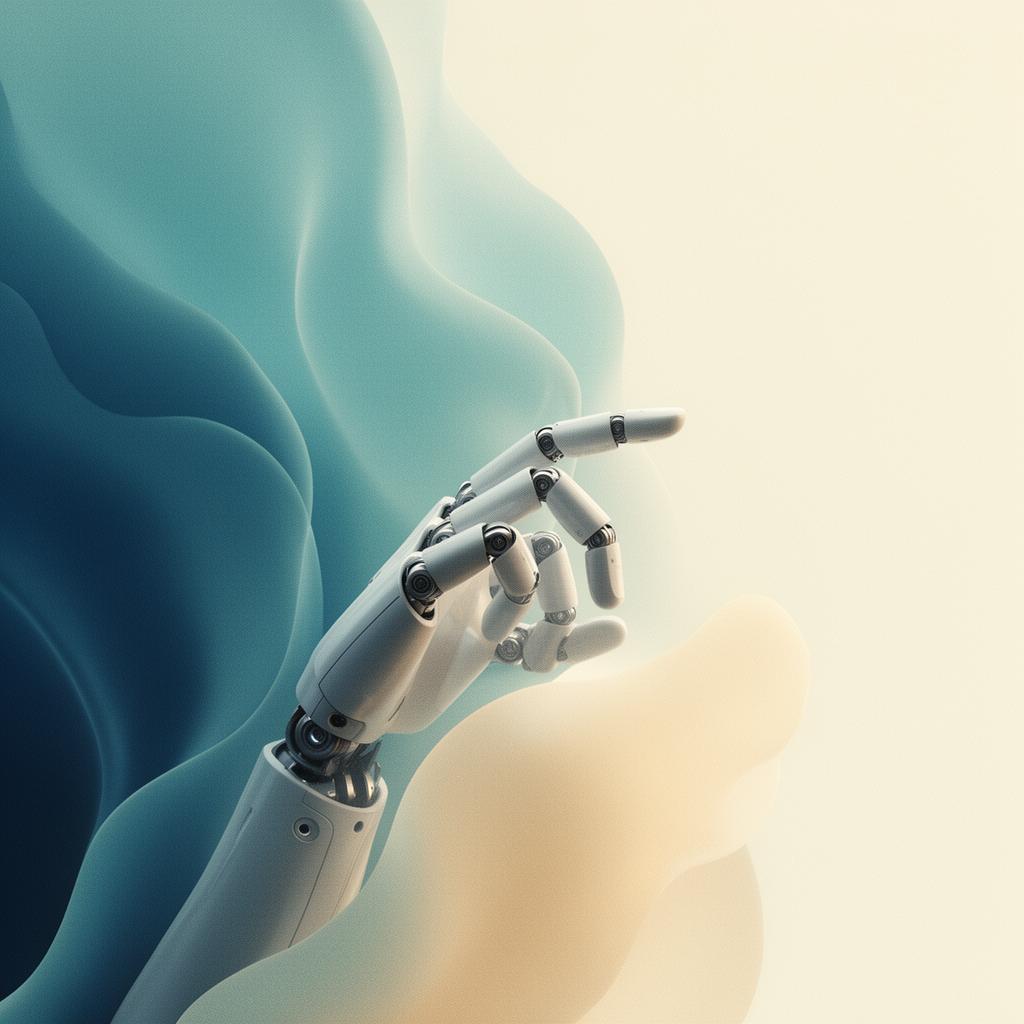
For decades, Artificial Intelligence lived in a box. It processed text, analyzed pixels, and solved equations, but it was essentially a “brain in a vat.” It could describe a glass of water, but it couldn’t pick one up.
That is changing. We are entering the era of Embodied AI—where intelligence is no longer just about thinking, but about doing.
The “Moravec’s Paradox” Problem
In the AI world, there is a famous observation known as Moravec’s Paradox: high-level reasoning (like playing world-class chess) requires very little computation, but low-level sensorimotor skills (like walking across a cluttered room or feeling the ripeness of an avocado) require enormous computational resources.
Computers conquered the “hard” things first. Now, they are tackling the things we do without thinking. To truly understand the world, an AI cannot just observe it through a screen; it must touch it.
Tactile Intelligence: More Than Just Gripping
When we talk about “touch” in AI, we aren’t just talking about mechanical claws. We are talking about haptic feedback loops.
Humans have roughly 17,000 mechanoreceptors in each hand. This allows us to sense texture, temperature, slip, and pressure instantly. For an AI to function in a human environment—like a hospital, a kitchen, or a warehouse—it needs a digital equivalent of this “tactile sense.”
- Proprioception: The AI’s awareness of its own body parts in space.
- Force Sensitivity: Knowing the difference between the pressure needed to crack an egg and the pressure needed to turn a doorknob.
- Material Recognition: Understanding through touch whether a surface is silk, sandpaper, or ice.
Why “The Body” Changes “The Mind”
Embodied AI suggests that intelligence is not a separate entity from the physical form. When a robot learns to navigate a physical space, its “learning” is fundamentally different from a LLM reading a textbook.
Physical interaction provides a grounding for language. An AI that has physically felt the weight of an object understands “heavy” in a way a chatbot never can. This grounding is the key to solving the hallucination problem; the physical world provides a “source of truth” that text data cannot.
The Boseer Vision: Moving Beyond the Screen
At Boseer, we see the transition to embodied AI as the final bridge between digital potential and physical reality.
The future of technology isn’t just an assistant that organizes your emails; it’s an assistant that can help a person with limited mobility get dressed, or a system that can perform delicate repairs in environments too dangerous for human hands.
The Challenge of the “Sim-to-Real” Gap
The biggest hurdle today is the “Sim-to-Real” gap. It is easy to train an AI to move in a perfectly coded simulation. It is incredibly hard to make that same AI move in a world where floors are slippery, lighting changes, and objects aren’t where they’re supposed to be.
We are currently witnessing the birth of General Purpose Robotics, powered by foundation models that treat physical movement like a language. By “reading” millions of hours of human movement and “writing” their own physical responses, these machines are learning the grammar of the physical world.
Conclusion: A New Kind of Connection
“Touching” is perhaps the most human of all senses. It is how we bond, how we create, and how we navigate. By giving machines the ability to touch, we aren’t just making them more useful; we are making them more compatible with the messy, physical reality of human life.
The next revolution won’t happen on your screen. It will happen in the space between the machine and the world it finally gets to feel.
What specific aspect of embodied AI—like home robotics or industrial applications—should we dive into for the next post?
Leave a Reply